
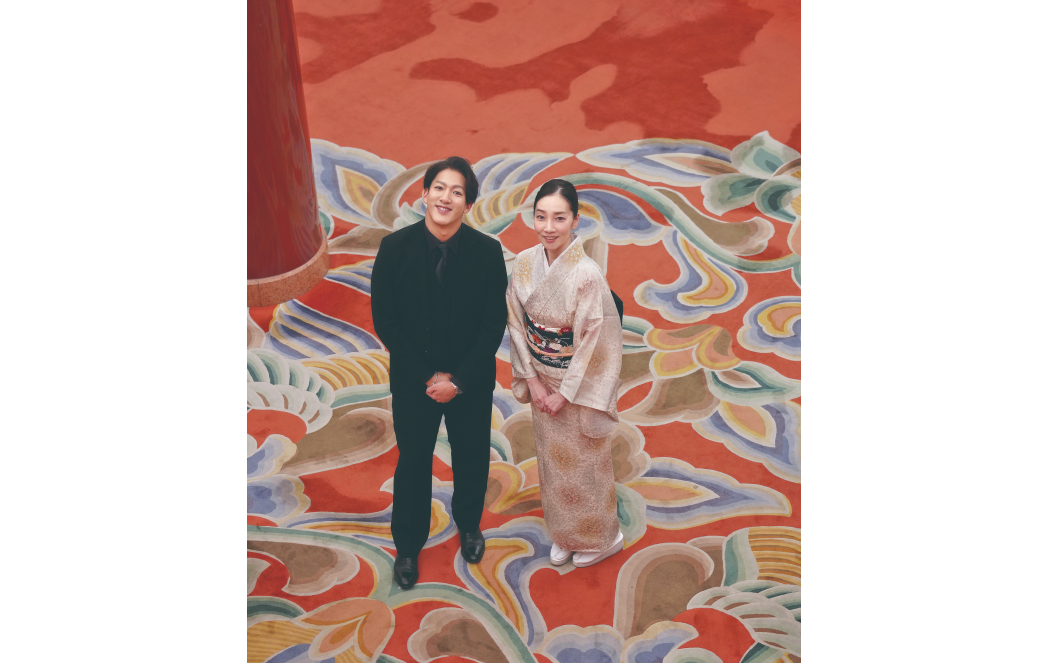
The loneliness — and transcendence — of playing the leading role
Onoe Ukon:
I think of the Onoe-ryu family as my "hometown." Its studio was across the street from my grandmother's building in Ginza, so it has always felt like a close relative.
Onoe Ukon:
I think of the Onoe-ryu family as my "hometown." Its studio was across the street from my grandmother's building in Ginza, so it has always felt like a close relative.
Onoe Yukari:
And I've been watching Ukon grow up ever since I was a little girl.
Ukon:
I started taking lessons from her father, Bokusetsu, when I was three years old. I vividly remember what the studio looked like back then — its color and texture, even the splinters on the rehearsal stage. That was thirty years ago, but the more time passes, the more I feel that the training I received from the Onoe-ryu school is a fundamental part of who I am. During my impressionable teenage years, I was sometimes overwhelmed by feelings of powerlessness and loneliness. I believe I was able to overcome these times because Bokusetsu had taught me my goal from the very start. To me, the Onoe-ryu family is rather like a "samurai family." The importance of keeping your feet on the ground and wrestling with the arts remains at the core of my being. The training I received there is a valuable asset.
Yukari:
I think it's a lonely life being an actor, especially for those who play leading roles. When I was 22, I danced the role of Shirabyoshi Hanako, the protagonist in Kyoganoko Musume Dojoji, which is considered the pinnacle of female dance. It really pushed me to the limit mentally — I was nearly crushed by the loneliness and pressure.
Ukon:
There's a realm that only those playing leading roles can understand. You can't get close to anyone. You put pressure on yourself, pressure to challenge yourself beyond your limits.
Yukari:
The reason I still carry on despite all that is that I love it. The training is tough, but I feel liberated when I'm on stage. I think I'm drawn to that moment.
Ukon:
For me, kabuki is simply fun. It is my purpose in life, and it is something I depend on – in a healthy way (laughs). It's lonely on stage, but there are also moments when you really feel that people are watching over and supporting you. Yukari, you had the experience of performing in Shanghai in a contemporary play last year. What left the strongest impression?
Culture, the performing arts, and peace
Yukari:
I felt that entertainment is something that can transcend national borders and unite people's hearts. On a larger scale, it contributes to peace, so the role of culture and the performing arts is even greater than we think. I felt fortunate to be involved in such a thing, and it gave me a greater sense of mission than ever before.
Ukon:
Things as natural as our eating or brushing our teeth can seem special to the outside world. When I performed in Mexico in 2024, I was asked what kind of actor I wanted to be. I said, "I come from a family that plays both male and female roles, so I don't think much about it that way. I want to be an actor that is liked for a variety of roles." Everyone applauded. It seemed natural enough to me, but the encounter made me realize that a special feeling is nurtured in the world of kabuki. People of many nationalities come to the Kabuki theater — I would like to convey to them Japan's cultural history and sensibilities, as expressed through kabuki.
Yukari:
I would like to share with the world the feelings and thoughts we have acquired growing up in the world of traditional Japanese culture. I believe there is a big role for us to play in that way.